
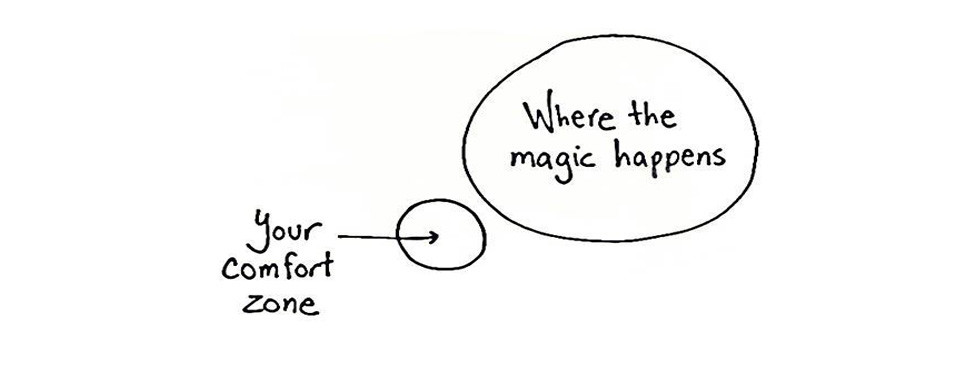
In the last couple of years, the figure above or some version of it has been circulating around the social media sites. The obvious idea behind it is that if you really want to achieve wonderful things and have “magic happen” in your personal and professional life, then you have to step out of your comfort zone and engage in some behaviors that you have always dreaded. The figure has been widely shared because it is intuitive and it energizes people to get out of their comfort circle and visualize where they need to go.
The problem with simplistic figures like this one though is they never tell you how to get from one circle to the other! Somehow, you are supposed to will yourself out of your comfort zone to the land of achievement and success. When I am coaching healthcare leaders, I occasionally encounter this situation: they know where they want to go and they are aware of what they have to do to succeed, but the required behaviors usually fall outside of their comfort zone. For example, I was working last year with a mid-career leader -let’s call him Jeff- who knew that in order to be more successful in his current job and to be considered for promotion for more senior positions, he had to become more assertive in dealing with his peers and superiors. By his nature, Jeff had always been the quiet, thoughtful type. In most work situations, he preferred to hold back rather than speak up. The results of his EQi 2.0 (Emotional Intelligence) assessment showed that “Assertiveness” was one of his lowest scoring sub-scales.
I asked Jeff why he thought he tended to hold back rather than speak up. After much introspection, he shared that he fears others’ retributions and that he may get fired for stepping over his boundaries. He also explained that he constantly finds himself thinking during meetings “If I say that, how will it be received? Will it create an argument or a negative outcome?” For fear of rocking the boat, he often choses to remain silent and maintain the status quo. Jeff is liked by his subordinates, is very good at what he does, and his ambition for success is limitless, but his lack of assertiveness was seriously jeopardizing his chances of getting noticed and recognized.
As we started identifying some of the behavioral changes that he needed to put in place, it quickly became obvious that these were types of behaviors that Jeff had purposefully avoided throughout his professional career. “I know that I need to express my opinions, to say no, and to assert myself, but these things don’t come naturally to me. It’s just not the way I am” he observed. What Jeff was experiencing is what psychologist and organizational behavior professor Andy Molinski calls the “authenticity challenge.” In his recent excellent book Reach, Molinski explains that one of the reasons people can’t get out their comfort zone is because they feel that acting in that way is foreign to who they are. It is basically the distress that comes from feeling that the behavior is not compatible with who the individual thinks he/she is as a person or as a leader.
As we discussed more, Jeff shared that he has always disliked people who are loud, super-assertive and who have no problem speaking their minds at every possible opportunity. This realization lead him to another major insight: he feared that if he spoke up more and expressed his opinions more forcefully, others might like him less. Molinski calls this the “likability challenge.” The authenticity and likability challenges were too strong for Jeff to overcome his limitations and stretch his comfort zones. Other challenges that people typically face when engaging in similar stretching behaviors include the competence challenge (“I am not good at this”), the resentment challenge (“I shouldn’t be doing this on top of everything else I have to do”) or the morality challenge (“this isn’t something that I should be doing”).
To empower Jeff to become more assertive, we had to start with helping him realize that devoting the necessary time and effort to make the changes was worth it. To enable him to develop a sense of conviction, I asked him to think of where his career would be in 5-7 years if he did not change anything in his behavior. When he thought about it from that perspective, he realized that if he didn’t start stretching himself soon, he would find himself stuck in a dead-end middle management position. “I would be resenting myself and feeling unfulfilled- I would feel like a total failure!” he observed.
Once Jeff reminded himself of the purpose of the behavioral changes, we designed a six-month plan that he customized for his own needs and preferences. It was not realistic to expect him to start interrupting senior executives in large meetings at once, so he worked on some small wins and behaviors that he could start doing right away, such as offering his opinion at least once in every small meeting that he attends, and saying no to busy-work requests that he typically received from some senior leaders who took advantage of his niceness.
Jeff’s progress was at first slow and tentative. But once he started implementing his plan, he gradually gained more confidence and engaged in more and more stretching behaviors. He was surprised that on most occasions, others really appreciated hearing his perspective. Some were very surprised with how insightful and intelligent he actually was. And his fears of getting involved in nasty arguments or of being reprimanded never materialized. The last time we spoke he shared that he was in the middle of interviews for a senior-level position in his hospital system. The magic was starting to happen for Jeff…
————————————————————————————————————-
Dr. Amer Kaissi is a Professional Speaker, Executive Coach and an expert on Leadership, Humility & Ambition, Assuming Positive Intent, Psychological Safety & Accountability, Growth Mindsets & Resilience.